
Chapter 01
How the trek works
Who's in the crew, who's actually in charge, and exactly what happens from the minute we roll into the Ely base to the morning we drive home.
Who's in the crew, who's actually in charge, and exactly what happens from the minute we roll into the Ely base to the morning we drive home.
2027 — camp dates, travel days extra
9 full days on the water
Scouts and adults in our crew
Acres of Boundary Waters wilderness
Every Northern Tier participant belongs to a crew. Ours is at least two adult leaders, a youth Crew Leader, and a majority of youth participants — plus a Northern Tier Interpreter who travels with us the entire trip.
If our troop brings enough Scouts for more than one crew, we get split into “sister crews.” Sister crews travel independently and will not see each other in the wilderness — that's deliberate, so each crew gets the real thing.
Picked early in planning. Leads the route discussion, sets the pace of travel each day, and builds the duty roster for camp chores. This is a real leadership job, not a title.
Counsel and coach to the Crew Leader, and responsible for the crew's safety. At least one adult must hold current Wilderness First Aid and CPR.
A trained Canoe Country Counselor. Teaches skills, helps plan the route, coaches the crew, handles all emergency communication, and brings the history and stories of the North Country to life.
Northern Tier calls it “part classroom, part instructor.” The weather, the wind and the portages do a lot of the teaching on this trip.
We're paddling out of the Charles L. Sommers Canoe Base in Ely, Minnesota — Northern Tier's oldest base, outfitting crews off Moose Lake since 1941 and over 4,000 participants a year.
From Ely, crews paddle the Boundary Waters Canoe Area Wilderness. Nestled in the Superior National Forest, the BWCAW is 1.1 million acres — the largest federally designated wilderness area in the contiguous United States. It stretches nearly 150 miles along the Ontario border and is known worldwide as a premier wilderness canoeing destination, with over 250,000 visitors a year.
Camping in the BWCAW is restricted to designated sites, each with a US Forest Service fire grate and a pit toilet.
Wilderness use is strictly limited by a permit system that caps how many groups enter each day. Northern Tier books our permit, and BWCAW permit fees are included in our trip cost.
Stay near the entry point and you'll see other groups. Plan a longer route and an expeditious crew can get away from contact with anyone else entirely.
Our trek stays in the United States, so there's no border crossing, no passport, and no international paperwork to chase down.
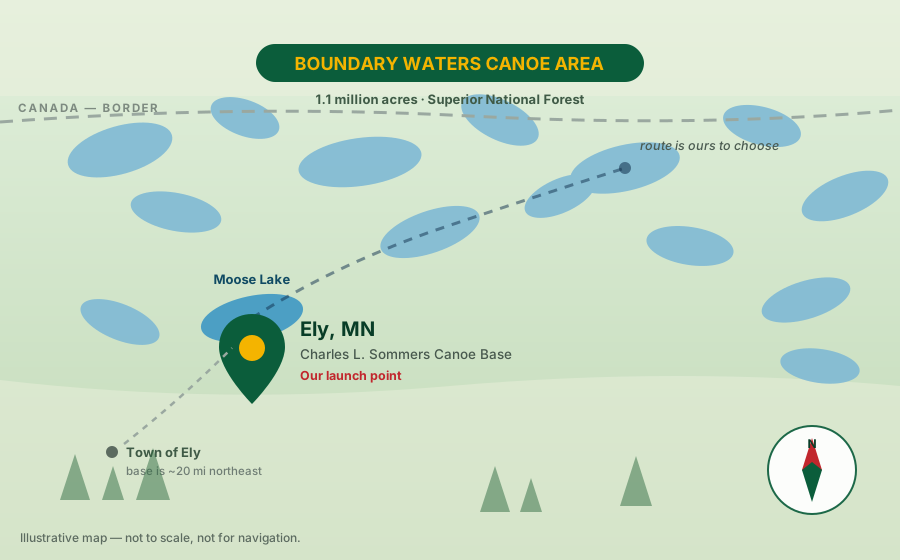
Here's the great part: there are no set routes. Our Interpreter helps the crew build the trip we actually want, based on current conditions — and with 10 nights, we have real range.
Show up with answers to these, because the crew will be asked:
Arrive between 1:00 and 3:00 PM. Eat lunch on the road — there's no lunch at base. Crews arriving after 3:00 may not finish check-in and will be delayed getting on the water.
Breakfast at 7:00 AM — wear your trail clothes. Then canoe check-out, food check-out, final gear check-out, and lock your personal items in the locker or vehicle. An efficient crew is on the water by 10:00 AM.
Eleven days at Northern Tier: a night on base, nine full days on the water with eight nights camped in the wilderness, then a final night back on base before the drive home.
Check in between 1:00 and 3:00 PM. Gear haul to the cabin, medical screening, outfitting, route planning and the gear shakedown. Dinner at 5:30, orientation, then a bunk in a rustic Northwoods cabin.
Breakfast at 7:00 AM in trail clothes. Canoe, food and final gear check-out, then on the water by 10:00 AM. First paddle, first real portage, first campsite.
Break camp, paddle, portage, make camp, hang the bear bag, repeat. This is where the crew finds its pace and the duty roster starts running itself.
The farthest point from the road. If the crew plans a layover day, this is usually where it lands — a full day at one campsite to fish, swim, explore and recover.
Working back toward the entry point. Last night in the wilderness — traditionally the one everybody remembers.
A final morning paddle to the entry point, returning to base after 1:00 PM. Gear check-in, then the shower and sauna you've been thinking about for a week and a half. Dinner in the dining hall and a last night in the cabin.
Breakfast, then depart base by 9:00 AM.
E061427-X reads as: E = Ely •
061427 = arriving June 14, 2027 • the trailing letter identifies the crew.
Letters X, Y and Z indicate a 10-night trip like ours (A–F are the 7 and 8 night trips).